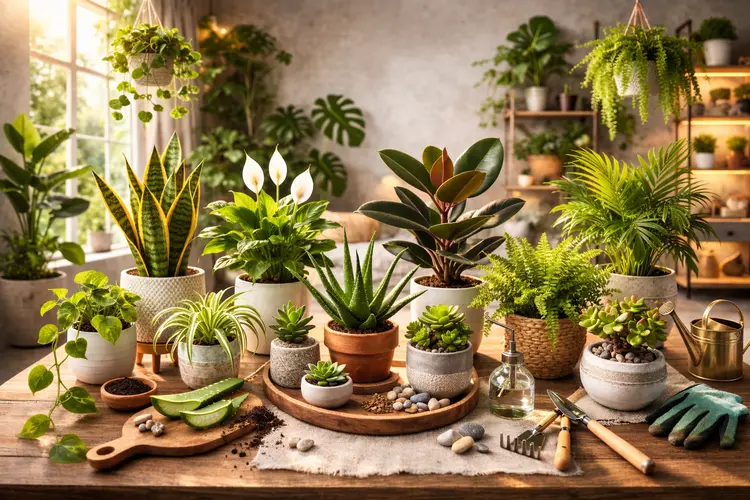
Indoor plants have evolved from simple living room ornaments into vital components of a modern, healthy lifestyle. As we spend more than 90% of our lives indoors—often in climate-controlled, digitally saturated environments—the “Urban Jungle” movement is no longer just a trend; it is a necessity for mental and physical restoration.
In this comprehensive 1,500-word guide, we will explore the biological wonders of indoor greenery, provide deep-dive profiles of the top 10 easiest plants to grow, and share the “trade secrets” that professional horticulturists use to keep plants thriving for decades.
1. The Biological Necessity of Indoor Greenery
Before discussing how to care for plants, it is essential to understand why our bodies and minds crave them. This connection is rooted in Biophilia, a term popularized by Edward O. Wilson, suggesting that humans have an evolutionary need to be surrounded by life.
A. The NASA Clean Air Legacy
In 1989, NASA’s “Clean Air Study” changed the way we look at houseplants. They discovered that in a sealed environment (like a space station or a modern energy-efficient home), plants act as living air scrubbers. They don’t just produce oxygen; they absorb Volatile Organic Compounds (VOCs).
- Formaldehyde: Found in plywood, carpets, and grocery bags.
- Benzene: Found in plastics, synthetic fibers, and detergents.
- Trichloroethylene: Found in printing inks, paints, and lacquers.
- Plants like the Snake Plant and Peace Lily break these chemicals down in their root zones, turning toxins into food for the plant.
B. The Psychological “Soft Fascination”
Our modern lives require “Directed Attention”—the intense focus needed for screens and spreadsheets. This leads to mental fatigue. Plants provide what psychologists call “Soft Fascination.” Looking at the complex patterns of a leaf or the slow unfurling of a new frond allows our directed attention to rest, significantly reducing stress, anxiety, and blood pressure.
2. Strategic Plant Selection: The “Three-Step” Audit
Most people fail with plants because they buy on impulse. To achieve a 10/10 success rate, perform this audit before heading to the nursery:
Step 1: The Light Map
Don’t guess; observe.
- South-Facing Windows: These provide intense, direct light. Only succulents (Aloe, Jade) and some palms thrive here.
- North-Facing Windows: These offer consistent but weak light. This is the kingdom of the Snake Plant and ZZ Plant.
- East/West Windows: These provide moderate, indirect light—the “sweet spot” for most tropical houseplants like Pothos and Monsteras.
Step 2: The Maintenance Reality Check
Be honest about your schedule. If you travel for two weeks at a time, a Boston Fern (which needs daily attention) is a poor choice. If you are a “nester” who spends every evening at home, you can handle high-maintenance species.
Step 3: The Safety Inventory
Check for toxicity. If your cat nibbles on leaves or your toddler explores everything with their mouth, you must avoid plants with Calcium Oxalate crystals (like Pothos and Peace Lilies) and stick to non-toxic options like Spider Plants and Palms.
3. Deep-Dive: The Top 10 Indoor Plants for 2026
1. The Snake Plant (Dracaena trifasciata)
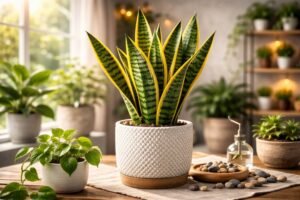
Once known as Sansevieria, this plant is the ultimate survivor.
- The Profile: Rigid, sword-like leaves that grow vertically. It comes in varieties like ‘Laurentii’ (yellow edges) or ‘Zeylanica’ (dark green waves).
- Advanced Care: It uses CAM photosynthesis, meaning it opens its pores at night to take in $CO_2$. This makes it the perfect bedroom companion.
- Common Pitfall: Watering into the center of the rosette. This causes “heart rot.” Always water the soil at the base.
- Safety: Toxic to pets.
2. The ZZ Plant (Zamioculcas zamiifolia)
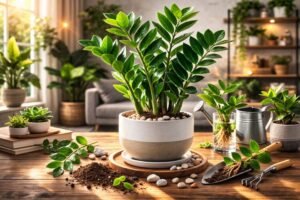
Originating from drought-prone regions of Africa, the ZZ is built for survival.
- The Profile: Waxy, emerald-green leaves that reflect light, making dark corners look brighter.
- The Secret: It grows from rhizomes—thick, potato-like bulbs under the soil that store water. This plant can easily go 6 weeks without a drink.
- Advanced Care: It grows very slowly. Do not over-fertilize trying to speed it up; this will only burn the roots.
- Safety: Toxic to pets.
3. Pothos (Epipremnum aureum)
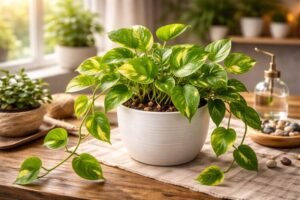
Often called “Devil’s Ivy” because it’s so hard to kill.
- The Profile: A trailing vine with heart-shaped leaves. Varieties like ‘Golden Pothos’ or ‘Marble Queen’ add stunning variegation.
- The Secret: It is an excellent communicator. When thirsty, the leaves lose their shine and droop. After watering, they “snap” back to life.
- Propagation: Snip a vine with at least 3 leaves, put the cut end in a glass of water, and watch roots grow in 10 days.
- Safety: Toxic to pets.
4. Peace Lily (Spathiphyllum)
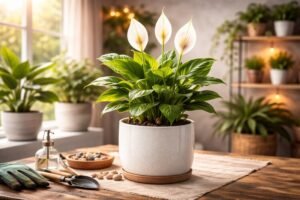
The queen of elegance and the best air-filter on this list.
- The Profile: Deep green foliage with striking white spathes (which are actually specialized leaves, not flowers).
- Advanced Care: They hate chemicals. If you see brown tips, it’s a reaction to the chlorine in tap water. Use filtered or rainwater.
- Safety: Highly toxic to pets.
5. Spider Plant (Chlorophytum comosum)
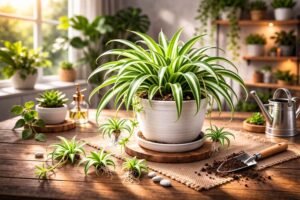
The most generous plant in the world.
- The Profile: Long, grassy leaves with white stripes.
- The Secret: It produces “spiderettes”—miniature clones of itself that hang down on long runners. You can clip these and give them to friends.
- Safety: 100% Pet and Child Safe. It is also non-hallucinogenic but cat-attractive (cats love the “bouncy” leaves).
6. Areca Palm (Dypsis lutescens)
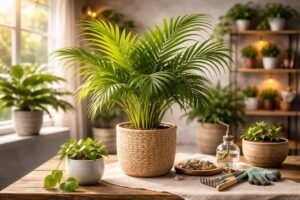
The “Living Humidifier.”
- The Profile: Soft, feathery fronds that create a screen of privacy.
- The Secret: One Areca Palm can release nearly 1 liter of water into the air every 24 hours, making it a natural alternative to an electric humidifier.
- Safety: 100% Pet and Child Safe.
7. Aloe Vera
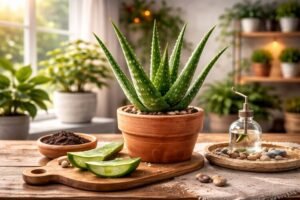
The functional succulent.
- The Profile: Thick, fleshy leaves filled with a soothing gel.
- Advanced Care: It needs a “Cactus Mix” soil (mostly sand and perlite). If kept in regular potting soil, the roots will suffocate and rot.
- Safety: Toxic to pets if eaten, but the gel is great for human skin.
8. Rubber Plant (Ficus elastica)
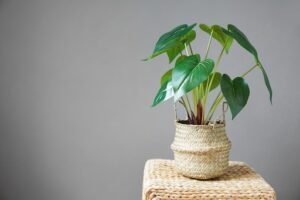
The interior designer’s favorite for a “Modern-Industrial” look.
- The Profile: Massive, waxy leaves in deep burgundy or dark green.
- Advanced Care: These plants are sensitive to changes. Once you find a spot where it’s happy, do not move it. Moving a Ficus can cause it to drop all its leaves in a week.
- Safety: Toxic to pets.
9. Boston Fern (Nephrolepis exaltata)
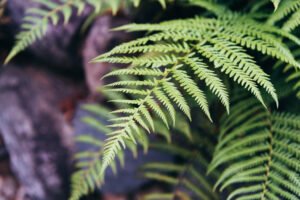
The timeless classic for high-humidity homes.
- The Profile: Frilly, delicate fronds that look stunning in hanging baskets.
- Advanced Care: It hates dry air. If your home is dry, keep the fern in the bathroom or place the pot on a tray filled with pebbles and water.
- Safety: 100% Pet and Child Safe.
10. Jade Plant (Crassula ovata)
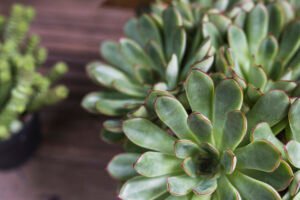
The “Money Tree” that lives for generations.
- The Profile: A miniature tree-like structure with thick, oval leaves.
- The Secret: They are extremely long-lived. In some cultures, Jade plants are passed down from grandparents to grandchildren.
- Safety: Toxic to pets.
4. The Master Class in Plant Care
Pillar I: The Potting Mix Revolution
Never use “Garden Soil” inside a house. It is too heavy, doesn’t allow air to reach the roots, and often contains dormant pests.
- The Standard Indoor Mix: 60% Coco-peat or Peat Moss, 20% Perlite (the white “popcorn” bits for drainage), and 20% Vermicompost (natural fertilizer).
Pillar II: Watering Mastery (The 80/20 Rule)
80% of indoor plants die from overwatering; only 20% die from thirst.
- The Bottom Watering Technique: Instead of pouring water on top, place your plant in a bowl of water for 20 minutes. The soil will “wick” up exactly what it needs, preventing the top layer of soil from getting soggy (which attracts gnats).
Pillar III: Seasonal Adjustments
Plants have a “Biological Clock.”
- Spring/Summer: This is the growing season. They need more water and monthly liquid fertilizer.
- Autumn/Winter: They go into dormancy. Growth stops. Stop fertilizing and reduce watering by 50%.
5. Troubleshooting: Common Plant Ailments
- Symptom: Yellow Leaves. * Cause: Usually overwatering (Root Rot).
- Fix: Check the drainage hole. If the soil smells like rotting vegetables, repot immediately in dry soil.
- Symptom: Brown, Crispy Edges.
- Cause: Low humidity or chemical burn from tap water.
- Fix: Mist the plant daily or use filtered water.
- Symptom: White Cotton-like Spots.
- Cause: Mealybugs.
- Fix: Dip a cotton swab in Rubbing Alcohol and dab the bugs directly. They will turn brown and die instantly.
- Symptom: Stretching and Thin Stems.
- Cause: “Etiolation” (starving for light).
- Fix: Move the plant closer to a window.
6. Comprehensive FAQs for the Modern Indoor Gardener
Q: Do indoor plants really remove enough $CO_2$ to matter?
A: While one plant won’t change the $CO_2$ levels of a whole house, a “cluster” of 5-10 plants in a bedroom can significantly improve the air quality and humidity in that specific micro-zone.
Q: Why do my plants always get tiny black flies?
A: Those are Fungus Gnats. They live in the top 1 inch of wet soil. To kill them, let the soil dry out more between waterings and cover the top layer of soil with decorative sand or gravel to prevent them from laying eggs.
Q: Can I use “Leaf Shine” sprays?
A: Professional horticulturists avoid them. Most leaf shines contain oils that can clog the stomata (pores) through which the plant breathes. Instead, wipe leaves with a mixture of 90% water and 10% milk for a natural, healthy shine.
Q: How do I know when to repot my plant?
A: Look for three signs: 1. Roots coming out of the drainage holes. 2. Water running straight through the pot without soaking in. 3. The plant looks too “top-heavy” for its container. Always move up only one pot size (e.g., from a 6-inch pot to an 8-inch pot).
Q: Is “Grey Water” (from the shower or kitchen) safe for plants?
A: Only if the soap you use is biodegradable and salt-free. For most indoor plants, it’s safer to use rested tap water (water that has sat out for 24 hours).
Conclusion: Crafting Your Living Sanctuary
Indoor gardening is more than just a hobby; it is a relationship with a living being. It teaches us the “slow pace” of nature in a world that is increasingly fast. By choosing the right species—be it a hardy Snake Plant or a lush Areca Palm—and mastering the fundamentals of soil, light, and water, you can transform your home into a thriving sanctuary.
Start small, observe the subtle signals your plants give you, and don’t be afraid to make mistakes. Every dead leaf is a lesson on the way to a greener life.
For more info visit :- dailyhomediy.com