Address
304 North Cardinal
St. Dorchester Center, MA 02124
Work Hours
Monday to Friday: 7AM - 7PM
Weekend: 10AM - 5PM
Address
304 North Cardinal
St. Dorchester Center, MA 02124
Work Hours
Monday to Friday: 7AM - 7PM
Weekend: 10AM - 5PM
Construction sites are busy environments where multiple activities happen at the same time—heavy machinery moves around, workers operate tools, and materials are lifted or installed. Because of this complexity, construction projects carry a higher risk of accidents compared to many other industries.
One of the most effective ways to prevent injuries and manage workplace risks is through an Activity Hazard Analysis (AHA). This safety process helps identify potential dangers before work begins and ensures that proper precautions are in place.
In this guide, we’ll explain what an AHA is, why it matters in construction projects, and how companies can create an effective Activity Hazard Analysis plan.
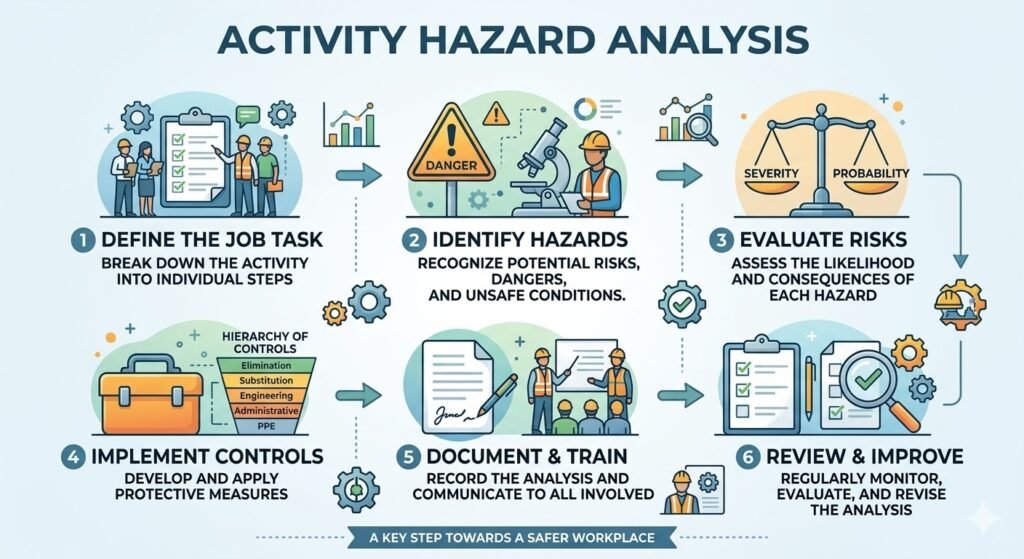
An Activity Hazard Analysis (AHA) is a structured safety document used to identify hazards associated with specific work activities and determine the best ways to control those risks.
It breaks down a job into individual steps and evaluates:
The tasks involved in the activity
Potential hazards linked to each task
Risk levels before safety controls
Preventive measures to reduce or eliminate danger
This method is also commonly called Job Hazard Analysis (JHA) or Job Safety Analysis (JSA) in many industries.
The goal is simple: identify risks before work starts so accidents never happen in the first place.
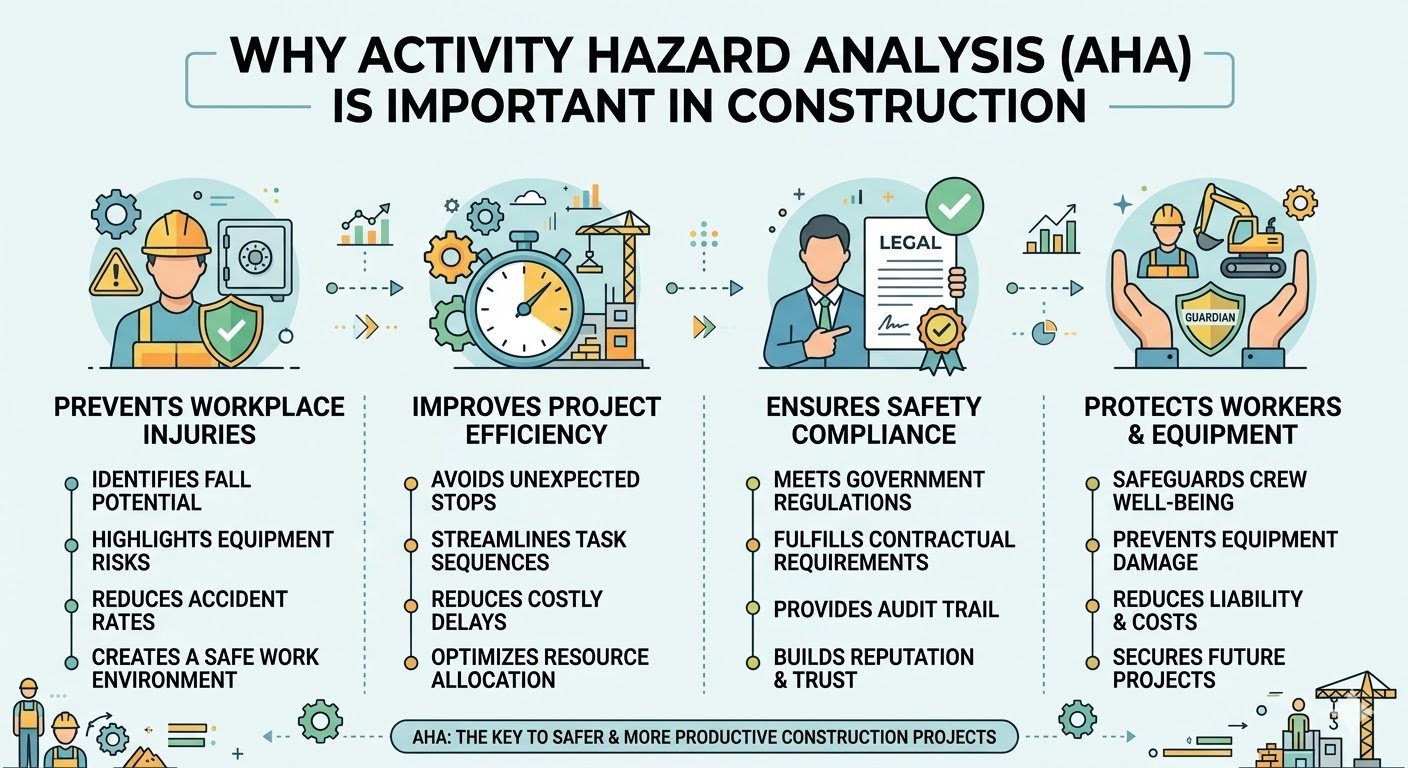
Construction work involves constant changes in environment, equipment, and procedures. Without proper safety planning, even routine tasks can become dangerous.
Implementing an AHA offers several benefits:
By identifying hazards early, workers can avoid dangerous situations such as falls, equipment accidents, or exposure to harmful materials.
When safety risks are addressed before starting work, projects face fewer delays caused by accidents or unexpected issues.
Many government projects and large construction contracts require AHAs as part of safety regulations.
Safety planning reduces damage to equipment, prevents costly downtime, and creates a safer working environment.
A well-prepared AHA includes several important elements that guide workers and supervisors throughout the project.
The first step is clearly describing the activity that will take place. For example:
Excavation work
Concrete pouring
Steel erection
Electrical installation
Each activity must be analyzed separately.
The activity is divided into smaller steps to analyze risks accurately.
Example for concrete pouring:
Preparing the formwork
Positioning concrete pumps
Pouring the concrete
Leveling and finishing
Breaking the job into steps helps identify hazards more precisely.
Once tasks are defined, the next step is identifying potential dangers. A hazard is anything that could cause injury, illness, or damage.
Common construction hazards include:
Falls from heights
Equipment collisions
Electrical hazards
Falling materials
Exposure to dust or chemicals
Recognizing these risks early helps prevent accidents.
After identifying hazards, the risk level is assessed based on two factors:
Severity of possible injury
Likelihood of the hazard occurring
This evaluation helps prioritize which hazards require immediate attention.
The final step is implementing safety controls to eliminate or reduce risks.
Common safety controls include:
Engineering controls (guardrails, machine protection)
Administrative controls (training, procedures)
Personal protective equipment (PPE)
Using multiple control measures creates a safer work environment.
Developing a successful Activity Hazard Analysis requires collaboration between supervisors, engineers, and workers.
Workers understand the daily risks on site better than anyone. Their input helps identify hazards that management might overlook.
Analyzing previous accidents or near-miss events can reveal recurring safety issues that must be addressed.
Every AHA should be documented clearly so workers can review safety procedures before starting work.
Workers must understand the hazards and safety controls described in the AHA.
An AHA is a living document that should be updated whenever site conditions, equipment, or procedures change.
Some tasks are especially high-risk and should always have an Activity Hazard Analysis prepared beforehand.
Examples include:
Scaffolding installation
Excavation and trenching
Crane operations
Roofing work
Demolition projects
Electrical installations
For complex or unfamiliar tasks, an AHA becomes even more critical.
To get the most value from an AHA, construction companies should follow these best practices:
Conduct safety meetings before starting work
Ensure supervisors review AHAs daily
Encourage workers to report hazards
Keep documentation accessible on site
Continuously monitor safety performance
Safety should never be treated as a one-time process—it must be part of daily operations.
While an AHA is a powerful safety tool, its success depends on the overall safety culture of a construction company.
Organizations that prioritize safety:
Train employees regularly
Encourage open communication
Investigate incidents thoroughly
Continuously improve safety procedures
When safety becomes part of the company culture, accidents decrease and productivity increases.
An Activity Hazard Analysis (AHA) is one of the most important safety tools used in construction projects. By breaking down tasks, identifying hazards, and implementing preventive measures, companies can significantly reduce workplace accidents and improve operational efficiency.
In an industry where risks are part of daily work, proactive safety planning makes all the difference. Implementing an effective AHA ensures that construction teams can complete projects safely, efficiently, and responsibly.