Address
304 North Cardinal
St. Dorchester Center, MA 02124
Work Hours
Monday to Friday: 7AM - 7PM
Weekend: 10AM - 5PM
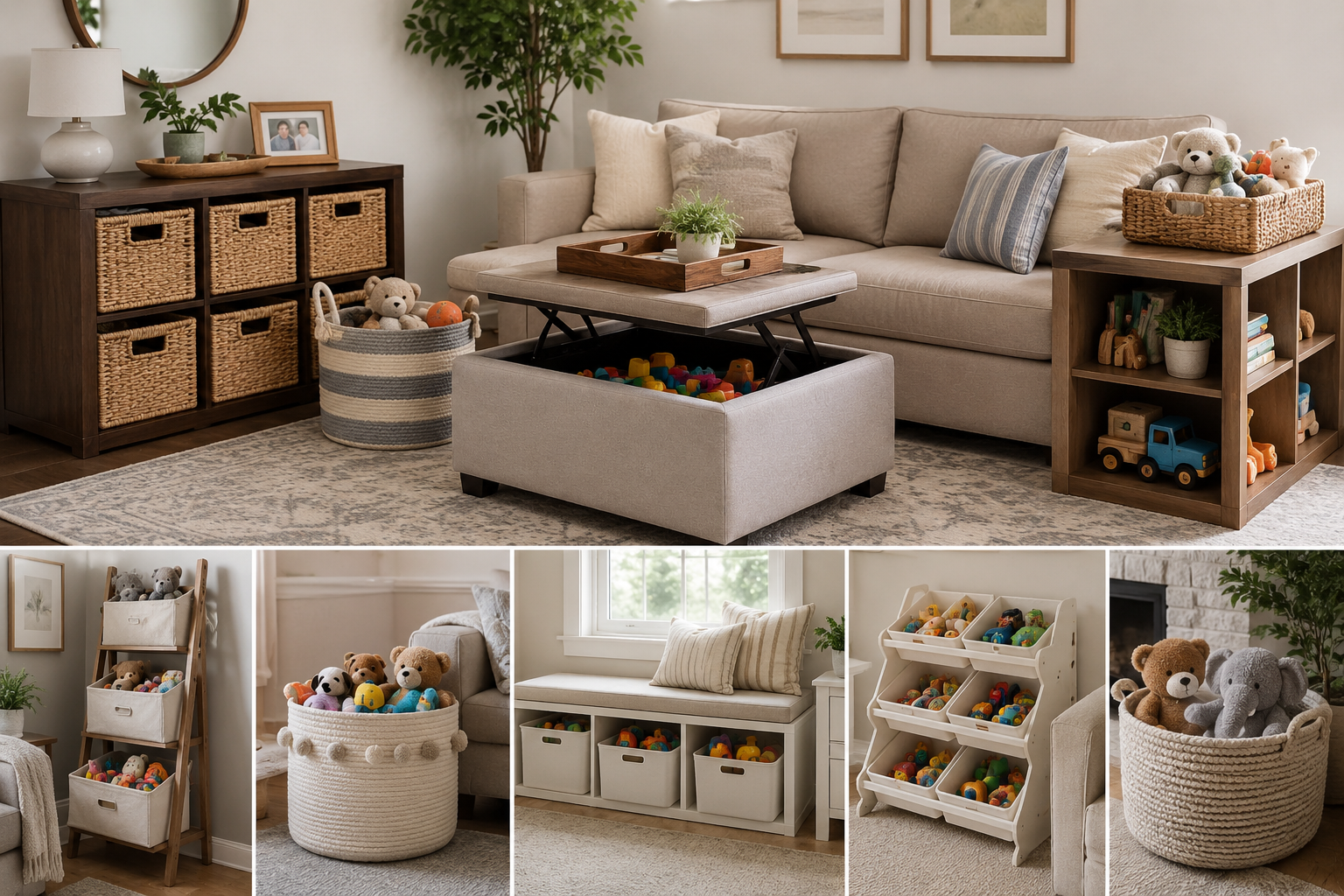
Let me be completely honest with you — I’ve stepped on a LEGO at 2 a.m. more times than I care to admit.
If you’re a parent, you already know that toys have a supernatural ability to multiply and migrate from the kids’ room straight into the living room. And once they’re there? They just… stay. On the couch. Under the coffee table. Somehow inside your throw pillow.
The good news? You don’t have to choose between a kid-friendly home and a space that actually looks like adults live there too. With the right toy storage ideas for your living room, you can hide the clutter almost instantly — even in a tiny apartment or a small shared space.
Here are 15 genuinely brilliant storage ideas I’ve either tried myself, spotted in real homes, or researched obsessively so you don’t have to.
If there’s one piece of furniture every parent of small kids should own, it’s a storage ottoman.
It looks like stylish seating. It acts like a toy chest. You sit on it, guests sit on it, and literally nobody knows it’s hiding 47 plastic dinosaurs inside.
Pro tip: Go for a lidded ottoman with a tray on top so it works as a coffee table too. Neutral colors like grey, beige, or cognac leather blend effortlessly into most living rooms.
Best for: Stuffed animals, board games, dress-up clothes, and anything soft that doesn’t need to be grabbed in a hurry.
If you have a window nook, an entry area, or even just one wall you haven’t used yet — a built-in bench with storage bins underneath is a game-changer.
You get seating and deep pull-out bins or baskets that are completely hidden behind a skirt or cabinet doors. It looks intentional and architectural rather than “I needed somewhere to dump the Play-Doh.”
Budget version: IKEA KALLAX units turned on their side with a cushion on top — classic, affordable, and endlessly customizable.
Here’s the thing about open bookshelves — they look great in magazine photos and absolute chaos in real life when kids are involved.
The fix? Swap out some shelves for large woven baskets or fabric bins. Group toys by type into each basket, and suddenly the shelf looks curated and calm instead of like a toy explosion.
Wicker, seagrass, and jute baskets are trending hard in 2026 because they’re sustainable, beautiful, and cheap enough to replace when they inevitably get crayon on them.
Labels help a lot here — even just a simple chalkboard tag so kids (and you) know where things actually go.
This one sounds a little utilitarian, but hear me out — pegboards have had a serious glow-up.
Modern pegboards come in natural wood, white, and even pastel tones. Mount one in a corner of the living room with hooks, small baskets, and ledges, and you’ve got an interactive toy wall that kids actually love using.
Art supplies, small toys, masks, costumes — all off the floor, all visible, all within reach.
Bonus: Kids are more likely to put things away when the storage is designed for them and feels fun.
If your kids are in their pretend-play era (and let’s be real, they all go through it), dedicate one corner cabinet with doors to all the kitchen and role-play toys.
Plastic food, tea sets, doctor kits — they all disappear behind two cabinet doors. Close it and the living room looks completely normal. Open it and the kids have their own little world.
You can use a repurposed sideboard, a small TV cabinet, or even a deep media console for this.
Look under your sofa right now. There’s probably 6–12 inches of dead space down there that’s currently being used by dust bunnies and lost socks.
Low-profile rolling storage bins slide perfectly under most sofas and can hold flat toys like puzzles, coloring books, drawing pads, and activity sets. Roll them out during playtime, push them back in when company’s coming.
Look for bins with handles at the front so even young kids can pull them out themselves.
The KALLAX-style cube storage unit (or any grid shelving) is genuinely one of the most versatile toy storage solutions out there.
The trick is in how you style it: alternate between open cubbies (display a plant, a book, a photo) and closed cubbies with fabric or wooden drawer inserts (toys go in there). The eye sees the pretty open cubbies; the closed ones hide everything else.
For small living rooms, a 2×4 or 4×4 configuration against one wall acts as both storage and a room divider if needed.
If your living room connects to an entryway or hallway, placing a storage bench right at the transition point creates a natural drop zone.
Kids come in, drop their backpacks and toys into the bench, and the mess never fully makes it into the living room. It’s less about storage design and more about traffic flow management — and it works incredibly well in practice.
Add hooks above it for bags and coats to complete the system.
A wooden or metal leaning ladder propped in a corner isn’t just a trendy decor piece — it’s actually pretty functional storage when you hang small wire or fabric baskets from each rung.
Smaller toys, car collections, action figures, and fidget toys all fit nicely. It takes up almost no floor space, looks like intentional decor from a distance, and can be moved easily when you need to vacuum.
If your kid is in the Magna-Tiles, magnetic car, or small metal toy phase, magnetic wall strips mounted low on the wall create instant storage that looks like modern art.
Seriously — a row of colorful magnetic tiles arranged on a strip? That’s a display, not clutter.
This idea works especially well in modern or Scandinavian-styled living rooms where clean lines are the goal.
An old wooden trunk or vintage chest at the foot of a sofa serves as a coffee table, footrest, and enormous toy storage unit all in one. It adds character to the room and gives you a truly cavernous amount of storage space.
Thrift stores, Facebook Marketplace, and estate sales are full of these for $30–$80. Sand them down, add a coat of chalk paint in a color that matches your room, and you’ve got a custom piece that looks expensive and hides a truly insane amount of toys.
Here’s an underrated combo: floating shelves at adult height (for books and decor) with small hooks mounted below at kid height for bags, backpacks, and hanging toy bins.
The upper zone stays adult-friendly. The lower zone belongs to the kids. It creates visual hierarchy in the room and teaches kids where their stuff actually lives.
If you’re the kind of person who needs to see things to find them (or your kids are), clear acrylic bins organized inside a cabinet work brilliantly.
Open the cabinet doors and everything is organized and visible. Close the doors and the living room looks clean and styled. No more “WHERE IS MY RED CAR” meltdowns because you can actually see where the red car is.
Label the bins with pictures (not just words) so even pre-readers can self-sort their toys.
This one’s more of a strategy than a furniture hack — but it might be the single most impactful thing you can do.
Instead of having all the toys accessible at once, rotate them. Keep 80% of toys in a closet or the kids’ room. Only one designated box or basket lives in the living room at a time.
Every week or two, swap it out. Kids think they’re getting new toys (they’re not). The living room stays manageable. Everyone is calmer.
A nice rattan hamper or linen bin works perfectly as “the living room toy box” because it looks intentional.
If you’re doing any kind of renovation or working with a carpenter, a window seat with deep drawers underneath is the ultimate small-space storage solution.
You get a cozy reading nook, extra seating for guests, and drawers that can swallow entire categories of toys — building blocks in one drawer, craft supplies in another, outdoor toys in the third.
Even if you’re renting, a freestanding version using two IKEA PAX or KALLAX units side by side with a custom cushion on top achieves a very similar look.
| Space Type | Best Storage Solution |
|---|---|
| Tiny apartment | Storage ottoman + under-sofa bins |
| Medium living room | Cube storage with mixed cubbies |
| Open-plan space | Room-divider shelving + baskets |
| Rental home | Leaning ladder + woven baskets |
| Own your home | Built-in window seat or bench |
Here’s what I’ve learned after years of fighting toy chaos in the living room — the best storage system isn’t the most beautiful one. It’s the easiest one to actually use.
If putting toys away takes more than 10 seconds, it won’t happen consistently. So whatever solution you choose, make sure:
Clutter is stressful. But with the right toy storage setup in your living room, you can go from “chaos” to “calm” in under five minutes — even on the busiest days.
Enter your email address below and subscribe to our newsletter