Address
304 North Cardinal
St. Dorchester Center, MA 02124
Work Hours
Monday to Friday: 7AM - 7PM
Weekend: 10AM - 5PM
Address
304 North Cardinal
St. Dorchester Center, MA 02124
Work Hours
Monday to Friday: 7AM - 7PM
Weekend: 10AM - 5PM
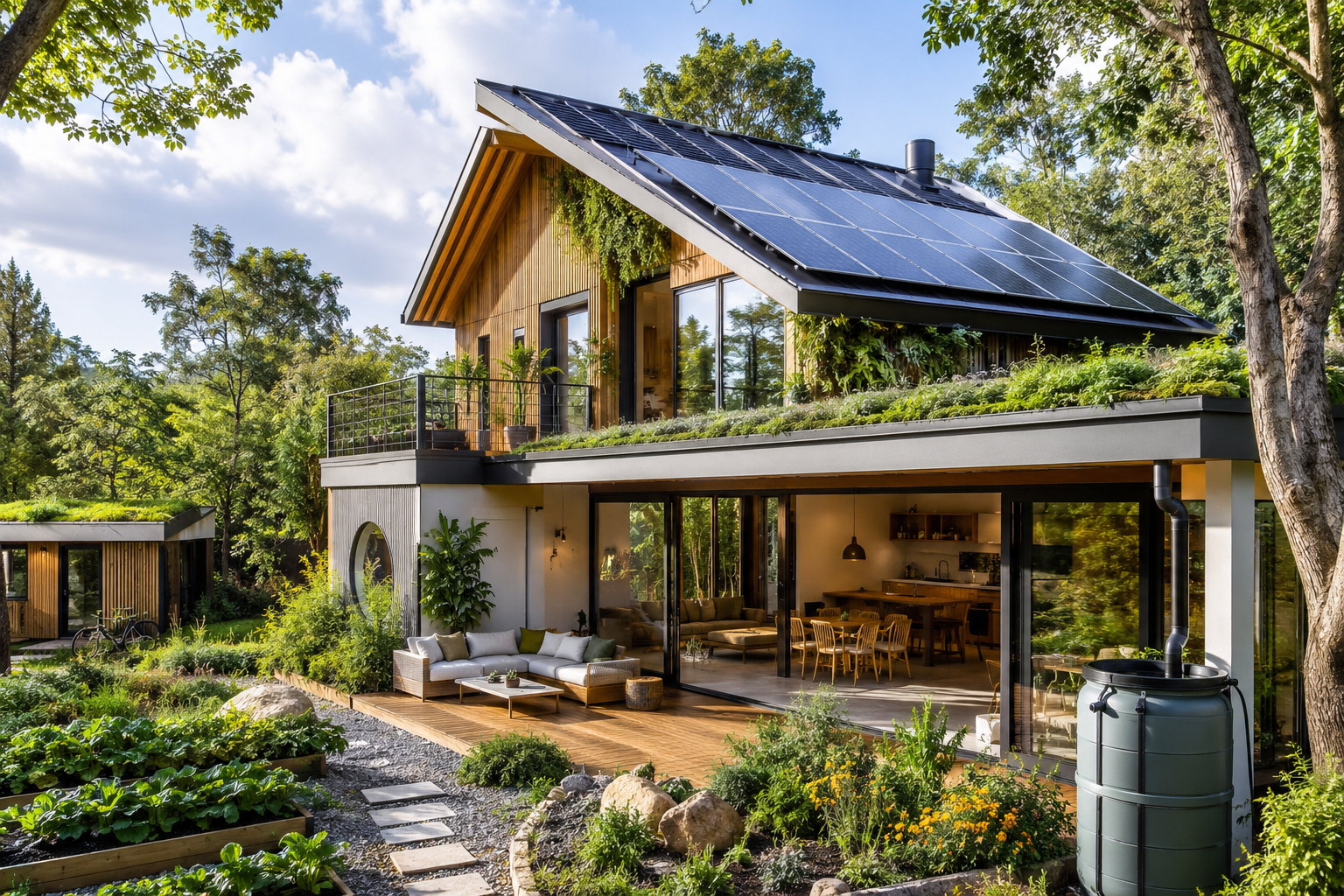
There’s a version of “eco-friendly home design” that most people imagine — rough hemp curtains, mismatched reclaimed wood everywhere, and a faint smell of patchouli. That version is over.
What’s replaced it in 2026 is something genuinely different: sustainable design that’s sophisticated, warm, and — this is the part that surprises people — often more beautiful than its conventional counterpart. The materials are richer. The craftsmanship is more intentional. The homes feel more grounded because they’re built with care rather than convenience.
This shift isn’t just an aesthetic one. The built environment contributes to 30% of global greenhouse gas emissions and accounts for one-third of global raw material consumption. That’s not a distant statistic — it’s the direct result of how we build, furnish, and maintain our homes. More homeowners are connecting those dots, and the design world has responded with ideas that make sustainability feel like the natural choice rather than a compromise.
This guide walks through the most important eco-friendly home design ideas for 2026 — not just what’s trending, but why it matters, what it actually costs, and how to start without overhauling your entire life.
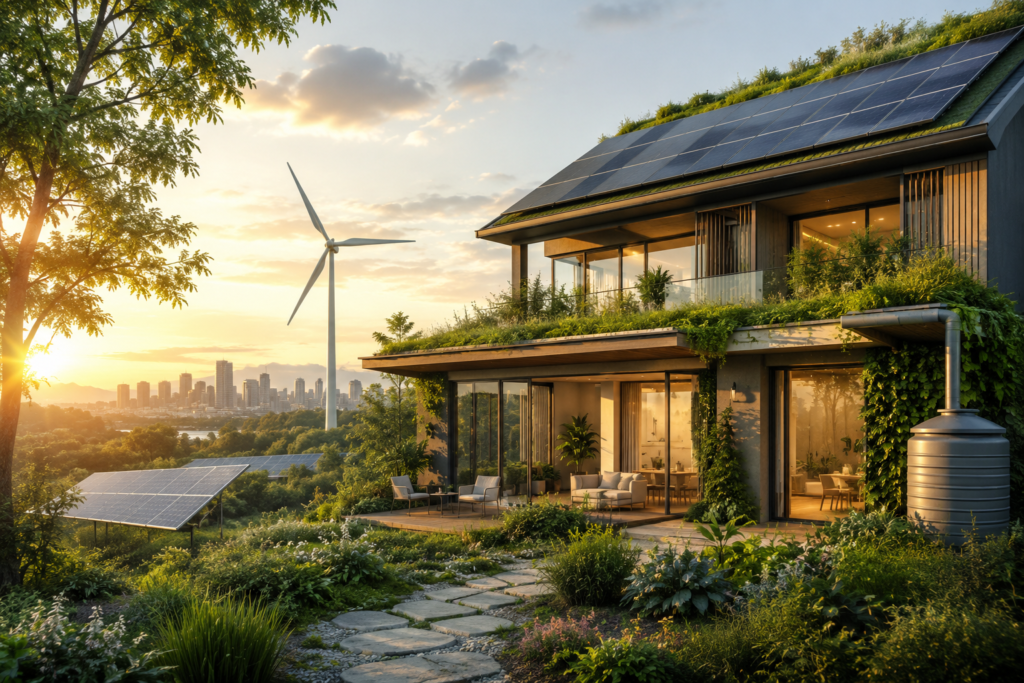
Sustainable home design has been gaining momentum for years, but something shifted recently. It’s moved from a niche movement for a particular kind of homeowner into the mainstream foundation of thoughtful interior design. You’re now more likely to find reclaimed wood and low-VOC finishes at a mid-range furniture store than in a specialist eco boutique.
A few things are driving this:
Cost has come down significantly. Solar systems now run between $16,000 and $25,000 after incentives, with payback periods of 7 to 11 years. Smart thermostats, energy-efficient appliances, and sustainable materials have all become more affordable as demand has scaled up.
The returns are measurable. Eco-friendly homes can reduce carbon emissions by 2 to 5 tons annually per household. More immediately, well-designed sustainable homes deliver $1,800 to $3,200 in annual energy savings. That’s real money, not a lifestyle statement.
The aesthetic has matured. Sustainable design in 2026 is sophisticated, stylish, and increasingly indistinguishable from conventional luxury design — except that it’s better for the planet. Homeowners are no longer willing to choose between beauty and responsibility, and designers have risen to meet that demand.
Health is part of the conversation. Toxic-free materials, better indoor air quality, and spaces designed around human wellbeing have become inseparable from the sustainability conversation. People aren’t just thinking about the planet; they’re thinking about the air their children breathe indoors.
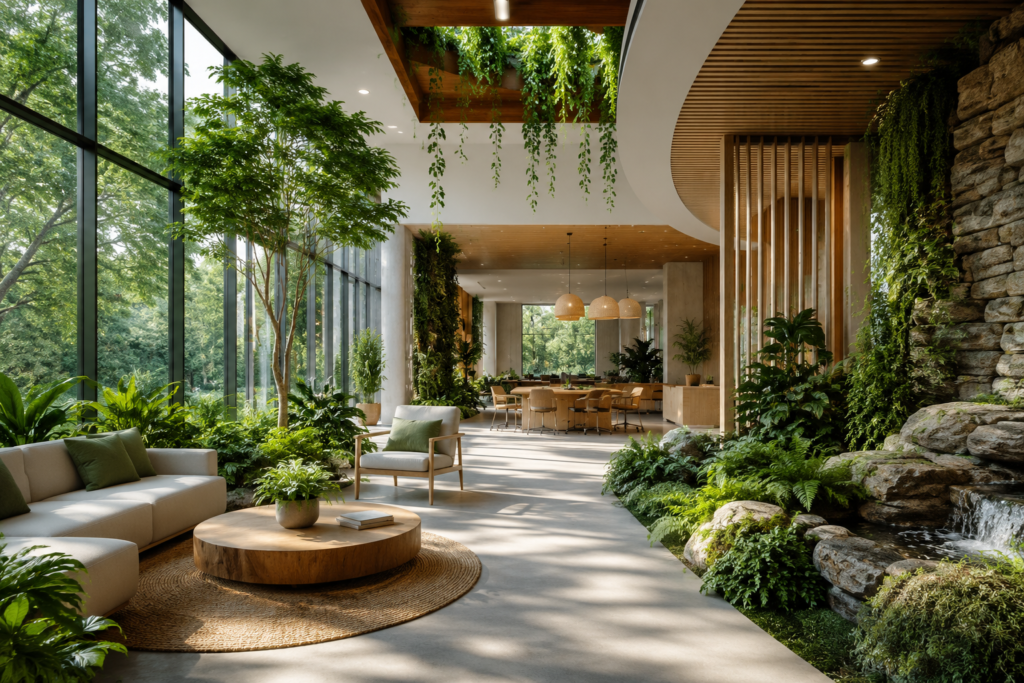
Biophilic design has been a buzzword for a few years, but in 2026 it’s moved well beyond scattering a few potted plants on windowsills. The idea is rooted in a straightforward observation: humans evolved in nature, and we still respond to it at a deep physical and psychological level. When we bring natural elements into our homes — not as decoration but as genuine environmental features — the effect on wellbeing is measurable.
What biophilic design actually looks like in 2026:
Living green walls are moving from restaurants and offices into homes. A vertical garden on an interior wall doesn’t just look striking — it absorbs carbon dioxide, releases oxygen, and helps regulate humidity. In a bedroom or living room, this is a genuine improvement to the quality of the air you’re breathing.
Sun-drenched design features. This means maximising natural light through strategic window placement, skylights, and open plan layouts that allow light to travel through a space. Natural light reduces your reliance on artificial lighting, supports your circadian rhythm, and makes a room feel inherently better.
Nature-inspired materials. Stone, untreated wood, rattan, linen, cork, and raw clay are all materials that maintain a visual and tactile connection to the natural world. In 2026, these aren’t rustic choices — they’re being used in sophisticated, contemporary interiors alongside warm neutral palettes.
Indoor food growing. Kitchen gardens, edible walls, and even compact hydroponic systems are becoming features in eco-conscious homes rather than curiosities. Growing your own herbs or leafy greens, even at a small scale, connects daily life to natural cycles in a way that purely decorative plants don’t.
The psychological benefits are worth taking seriously. People who live with biophilic design elements report lower stress levels, better sleep, and improved focus. When you feel genuinely good in your space, the impulse to constantly redecorate or accumulate diminishes naturally — which is itself a sustainability outcome.
Material choice is where eco-friendly home design gets specific, and where most guides fall into either vague generalities or impenetrable technical detail. Here’s a practical breakdown of the most important sustainable materials and what each one actually brings to a home.
Reclaimed wood — timber salvaged from old barns, warehouses, demolished buildings, and fallen trees — is one of the most beautiful and genuinely sustainable materials available. Reusing timber prevents new trees from being felled, eliminates the embodied energy of producing new timber, and adds character that no new wood can replicate. Each plank has a history that shows in its grain, colour, and texture.
In 2026, reclaimed wood is being used for flooring, wall cladding, furniture, kitchen cabinetry, shelving, and decorative beams. It’s become a marker of quality rather than compromise.
For new wood purchases, look for FSC (Forest Stewardship Council) certification. This guarantees the timber comes from responsibly managed forests where trees are replanted and ecosystems are protected.
Both bamboo and cork are fast-growing, renewable materials that offer genuine performance advantages alongside their environmental credentials.
Bamboo grows faster than almost any other building material — some species grow several feet in a single day — which means it can be harvested without depleting forests. As a flooring material, it’s harder than most hardwoods, naturally moisture-resistant, and available in a wide range of styles and finishes that work in contemporary interiors.
Cork is harvested by stripping the bark from cork oak trees, which then regrow their bark over the following nine years. No tree is cut down. Cork flooring is naturally antimicrobial, provides excellent thermal and acoustic insulation, and is completely recyclable. It’s also surprisingly soft underfoot — a quality that makes it particularly good in kitchens and bedrooms where you spend a lot of time standing or walking barefoot.
Recycled steel uses around 75% less energy to produce than virgin steel. Recycled glass countertops — made from post-consumer glass including bottles and windows — offer durability, heat resistance, and a distinctive, slightly translucent aesthetic that’s become genuinely fashionable in sustainable kitchen design.
Recycled metals appear in table bases, hardware, light fixtures, and decorative features. The visual difference between recycled and virgin metal is indistinguishable, but the environmental difference is significant.
These are less common but worth knowing about, particularly if you’re planning new construction or major renovation.
Hempcrete is a biocomposite made from the woody core of the hemp plant mixed with a lime binder. It provides excellent insulation, is breathable (which means it regulates humidity naturally), and actually sequesters carbon over its lifetime rather than releasing it. It’s not suitable as a structural material on its own but works exceptionally well as insulation within a structural frame.
Rammed earth — compacted layers of natural earth, sometimes stabilised with a small amount of cement — produces walls of great thermal mass that absorb heat during the day and release it slowly at night, significantly reducing heating and cooling energy requirements. It’s one of the oldest building techniques in the world, and it looks extraordinary: walls that appear to capture geological time in their layered strata.
This is one of the simplest and highest-impact changes you can make in any room. Conventional paints contain volatile organic compounds (VOCs) — chemicals that off-gas from the paint surface for months or years after application, degrading indoor air quality in ways that aren’t always obvious.
Low-VOC and zero-VOC paints have improved dramatically in quality over the past few years. The colour range is now effectively identical to conventional paints, and performance in terms of coverage, durability, and washability is comparable. There’s no good reason to use conventional paint in a living or sleeping space.
Mineral-based paints — made from natural silicates rather than synthetic resins — are particularly valued by sustainable designers. They bond molecularly with the surface they’re applied to, last significantly longer than conventional paint, and are entirely non-toxic.
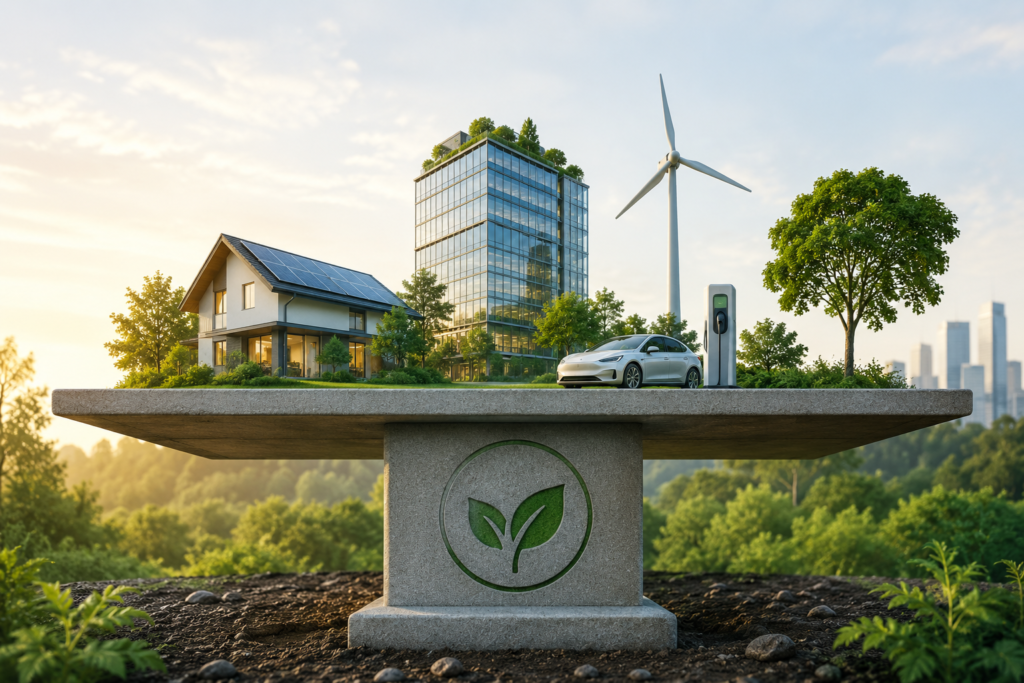
You can choose every sustainable material correctly and still have a fundamentally unsustainable home if it’s leaking energy. Energy efficiency isn’t the most glamorous part of eco-friendly home design, but it’s the part with the largest real-world impact.
Heat loss through poorly insulated walls, roofs, and floors is one of the biggest sources of wasted energy in homes. The EPA estimates that sealing air leaks and improving insulation can save 15% on heating and cooling bills — and that’s a conservative figure for older homes where insulation has deteriorated or was never adequate.
High-performance insulation in 2026 includes mineral wool, cellulose (made from recycled paper), spray foam for sealing gaps and cracks, and increasingly, insulation derived from natural materials like sheep’s wool, hemp, and wood fibre. These natural options offer comparable thermal performance to synthetic alternatives while being healthier to handle, easier to dispose of, and often better at managing moisture.
Windows are the biggest source of heat loss in most homes. Double-glazed windows are now effectively a minimum standard in new construction; triple-glazed windows, which were once considered premium, have come down significantly in price.
Beyond glazing, window frames matter. uPVC frames provide good insulation but are difficult to recycle. Timber frames are renewable, can be repaired, and have a lower embodied carbon footprint. Aluminium frames with thermal breaks offer excellent durability and are highly recyclable.
Aesthetics no longer suffer for the sake of power generation. Building-integrated photovoltaics (BIPV) replace traditional rack-mounted panels with solar shingles that generate power while looking like conventional roofing material. For homes where traditional panels work aesthetically, the financial case has never been stronger.
A solar system with battery storage allows a home to store excess energy generated during daylight hours for use at night and during overcast periods, significantly reducing grid reliance. AI-driven energy management systems can now predict weather patterns and adjust consumption accordingly — automatically running energy-intensive appliances when solar production is highest.
Smart thermostats like Nest and ecobee learn your habits, adjust temperatures based on occupancy and time of day, and can reduce energy bills by 10 to 15%. That’s a saving that accumulates every month for as long as the thermostat is installed.
Home energy management systems go further, monitoring consumption across all appliances and circuits in real time. They identify wasteful patterns — a fridge that’s running inefficiently, phantom loads from electronics left on standby, heating cycles that don’t match actual occupancy — and give you the information to address them.
ENERGY STAR certified appliances use around 40% less power than standard alternatives. When the time comes to replace a refrigerator, dishwasher, washing machine, or air conditioner, choosing an ENERGY STAR model is one of the highest-return sustainable investments a household can make.
The average household uses about 82 gallons of water per person per day. A significant proportion of that is wasted — through inefficient fixtures, leaks, and habits that predate any awareness of water scarcity.
Low-flow faucets, showerheads, and toilets reduce water flow without meaningfully affecting the experience of using them. An EPA WaterSense certified toilet can save 13,000 gallons of water per year compared to a standard model. Faucet aerators — inexpensive devices that mix air into the water stream — reduce flow by 30 to 50% while maintaining water pressure.
Toilets alone account for about 30% of household water use. Dual-flush models, which allow you to choose between a full and partial flush, are now standard in many countries and increasingly common in renovation projects.
Collecting rainwater for non-potable uses — garden irrigation, toilet flushing, washing — reduces demand on municipal water supplies and can cut household water consumption by 35 to 40%. The simplest systems are basic rain barrels connected to a downpipe. More sophisticated setups include underground cisterns, filtration systems, and pumps that integrate with home plumbing.
Greywater — water from sinks, showers, and washing machines, as distinct from blackwater from toilets — can be filtered and reused for garden irrigation and toilet flushing. Where local regulations allow it, greywater recycling is one of the most effective ways to reduce a household’s water footprint without changing any daily habits.
Smart water monitors track household water usage at the appliance and fixture level, identify leaks in real time, and can automatically shut off the water supply when abnormal flow patterns are detected. Leaks that go unnoticed for weeks — a dripping tap, a slow toilet leak — represent both significant water waste and potential structural damage. Detection and prompt repair is always the most effective intervention.
One of the most important sustainable design principles of 2026 has nothing to do with materials or technology. It’s a change in how we think about acquiring things for our homes.
The circular economy applies to home design in a straightforward way: instead of buying cheap things that need to be replaced every few years, you buy well-made things that last for decades, can be repaired when they break, and can be recycled or composted at the end of their life. A single solid wood dining table that lasts 50 years is more sustainable than five cheap tables replaced every decade. The economics actually work out in your favour, too — the cost per year of use favours quality every time.
Reclaimed, vintage, and antique furniture has seen a dramatic surge in 2026. This is the circular economy in its purest form: objects that already exist being given new use rather than new objects being manufactured. The appeal isn’t just environmental — vintage and antique pieces bring a specificity and character to a space that mass production genuinely can’t replicate.
An emerging practice in 2026 is the “material passport” — documentation that accompanies furniture or design elements, detailing every material used, where it was sourced, how it should be maintained, and how it can be recycled or composted at end of life. Still more common in commercial interiors, progressive residential designers are beginning to adopt this practice, creating a paper trail that ensures materials re-enter productive use rather than ending up in landfill.
This idea connects to a broader shift in how people are relating to their possessions — choosing things with stories, provenance, and accountability rather than anonymous, disposable objects.
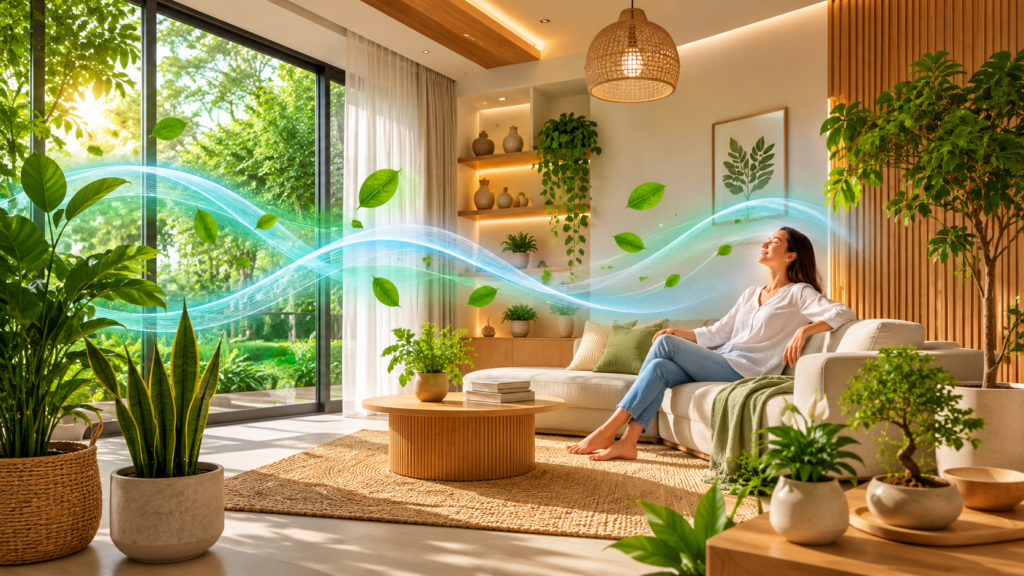
We spend roughly 90% of our time indoors. The quality of the air in our homes has a direct and measurable effect on our health, cognitive function, and sleep — and most people give it almost no thought when making design decisions.
Conventional home furnishings and finishes contain a long list of chemicals that off-gas into indoor air over their lifetimes: formaldehyde from pressed wood products, flame retardants in upholstery and mattresses, VOCs from paints and adhesives, and endocrine-disrupting plasticizers from vinyl flooring and PVC.
The shift to non-toxic interiors in 2026 involves:
Choosing formaldehyde-free wood products. Solid wood rather than MDF or particleboard, or engineered wood certified to CARB Phase 2 emissions standards as a minimum.
Selecting organic textiles. Organic cotton, linen, wool, and hemp grown without pesticides and processed without toxic finishes. For upholstery and bedding especially, where you’re in close, prolonged contact, the material choice matters more than most people realise.
Specifying low-VOC and zero-VOC finishes throughout. Paints, varnishes, adhesives, and sealants all contribute to indoor VOC levels. Choosing low-emission alternatives at every stage of a renovation or fit-out makes a cumulative difference to indoor air quality.
Using natural air purification. Certain indoor plants — peace lilies, snake plants, spider plants, and Boston ferns among them — absorb indoor pollutants as part of their natural biological processes. Combined with good ventilation (cross-ventilation is more effective and uses less energy than mechanical air purification in most climates), biophilic design elements contribute directly to indoor air quality.
Not every eco-friendly home improvement requires a significant investment or a full renovation. Some of the most effective sustainable design choices are things you can do yourself with minimal cost and a free afternoon.
Upcycling existing furniture. Before replacing a piece of furniture, consider whether it can be repaired, reupholstered, repainted, or repurposed. A tired wooden chair with damaged upholstery can become something genuinely beautiful with fabric from a remnant shop and an afternoon’s work. A scratched chest of drawers, repainted with quality chalk paint and fitted with new hardware, looks better than most new furniture at a fraction of the cost and none of the manufacturing footprint.
Repurposing materials. Old wine crates become wall shelves. Scaffolding boards become shelving or a workbench. Industrial metal pipes become curtain rails. Vintage ceramic tiles become a splashback. This kind of resourcefulness isn’t just economical — it produces interiors with a specificity and personality that can’t be bought off a shelf.
DIY insulation and draught-proofing. Draught-proofing around doors and windows is one of the highest-return DIY projects in terms of energy saving. Door seals, letterbox draught excluders, and window film can collectively make a noticeable difference to heating bills in older properties without requiring professional installation.
Composting. A kitchen compost system diverts organic waste from landfill where it would decompose anaerobically and produce methane — a greenhouse gas 25 times more potent than carbon dioxide. Compost returned to garden soil improves its fertility and structure. It’s one of the simplest, most effective things any household can do.
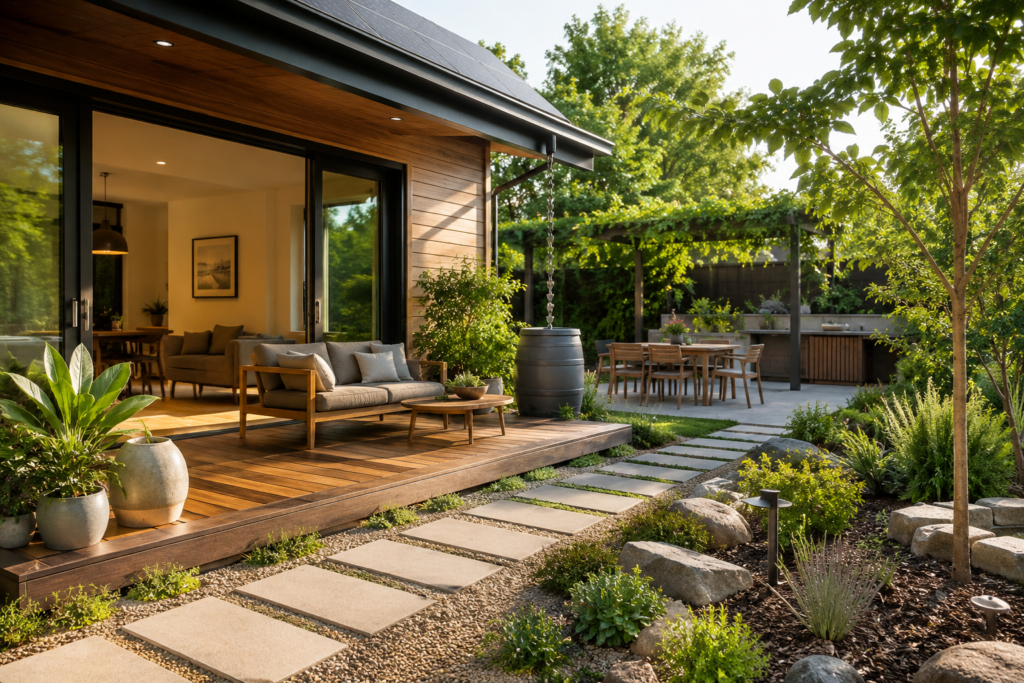
Eco-friendly design increasingly extends to gardens, patios, and balconies — spaces that have their own significant environmental impact through water use, chemical inputs, and how they interact with local ecosystems.
Native plants and biodiversity. Native plants — species that evolved in your local climate and ecosystem — require significantly less water and maintenance than exotic plants that need supplemental irrigation and protection from local pests. They also provide habitat and food for local wildlife: pollinators, birds, and beneficial insects that contribute to a healthy ecosystem beyond your garden boundary.
Permeable paving. Hard landscaping that allows rainwater to percolate through into the soil rather than running off into drains reduces flood risk, recharges groundwater, and reduces the urban heat island effect in cities. Permeable paving options include gravel, porous concrete, and interlocking block systems designed to allow water through.
Outdoor food growing. Whether it’s a raised bed vegetable garden, a few containers of tomatoes and herbs on a balcony, or a small fruit tree in a suburban garden, growing some of your own food reduces the embodied energy of the food chain and connects daily life to seasonal rhythms in a way that’s genuinely restorative.
Sustainable materials for outdoor structures. Decking, fencing, and garden structures are increasingly made from composite materials — usually a combination of recycled wood fibre and recycled plastic — that require no maintenance, don’t rot or splinter, and stay out of landfill. FSC-certified hardwoods are a good alternative for those who prefer natural wood with a clear conscience.
The most overlooked sustainable design idea is also the simplest: owning less.
Minimalism in 2026 doesn’t mean stark white rooms with single objects on pedestals. It means thoughtful selection — curating what you own based on quality, longevity, and genuine usefulness rather than accumulating through convenience or habit.
Fast decor fades quickly. It breaks, chips, or goes out of trend. You replace it again and again, and that cycle wastes money and materials in ways that individual sourcing decisions can’t compensate for. Buying fewer things — but things you’ve chosen carefully, that are well made, and that you actually want to live with — produces better interiors and significantly less waste.
This approach aligns with what leading designers consistently recommend: focus on a small number of high-quality pieces that anchor a space, then build around them with natural textiles, plants, and personally meaningful objects. A home furnished this way feels calm and real. It doesn’t try too hard. It feels easy, balanced, and lived in — which is what good design actually aims for.
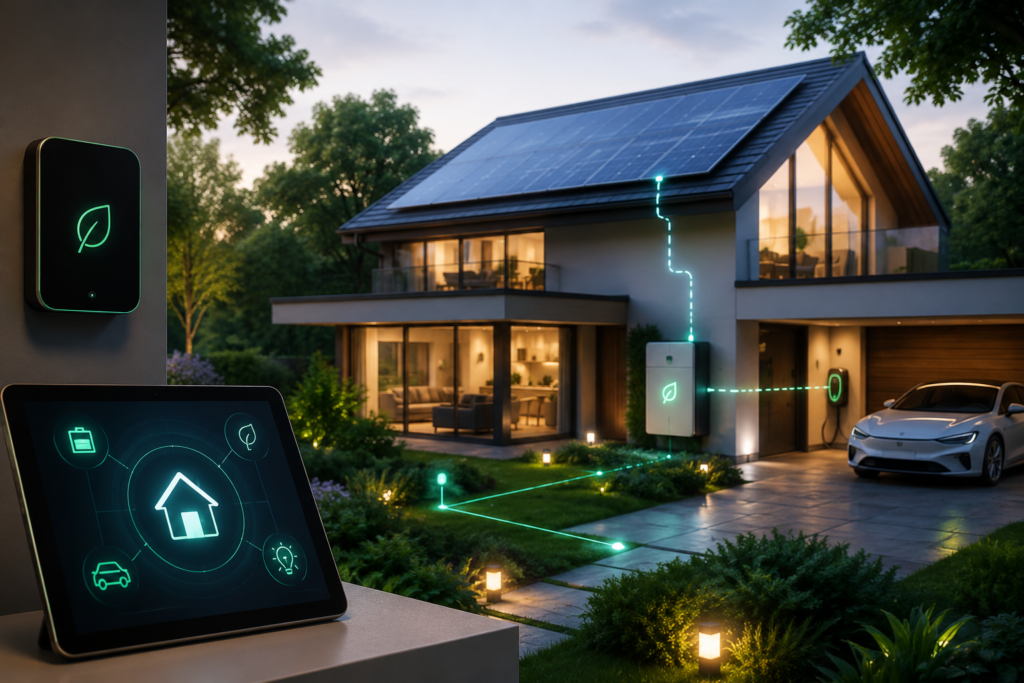
Smart home technology and sustainable living have converged significantly in 2026. The best smart home systems don’t just add convenience — they actively reduce waste.
Smart lighting. Motion sensors that turn off lights in empty rooms. Programmable systems that align lighting schedules with actual occupancy patterns. Daylight-harvesting systems that dim artificial lighting in response to available natural light. Around 6% of residential energy in the US goes to lighting; smart lighting systems can reduce this by 50 to 70%.
Energy monitoring. Real-time data on what each appliance and circuit is using makes energy waste visible and therefore addressable. Phantom loads — the energy consumed by electronics on standby — can account for 5 to 10% of household electricity use. A monitoring system makes this visible; addressing it is trivial once you can see it.
Smart irrigation. Systems that respond to weather data and soil moisture sensors water plants only when needed, eliminating overwatering — one of the most common and wasteful gardening habits. In a garden with a smart irrigation system, a rainy week means the system simply doesn’t run. In a conventionally timed system, the sprinklers run regardless.
Greywater and rainwater integration. Smart systems can now manage the routing and use of harvested water, integrating with home plumbing to use collected water for appropriate applications and switching to mains supply only when reserves are depleted.
Sustainable home design can feel overwhelming when presented as an all-or-nothing proposition. It isn’t. Every responsible choice compounds over time, and starting small is better than not starting.
Here’s a practical progression for different budgets and situations:
This week, for free or very little money:
This month, moderate investment:
This year, significant investment:
Longer term:
Sustainable home design has a reputation for being expensive, and in some cases that’s accurate. Hempcrete walls and building-integrated solar systems are not cheap. But the framing matters.
The upfront cost of eco-friendly homes is typically 9 to 18% higher than conventional construction. The annual savings — from energy efficiency, reduced maintenance, and lower utility bills — run between $1,800 and $3,200 per year. The payback period for most significant sustainable investments is 7 to 15 years, and the lifetime savings are substantially larger than the initial premium.
More importantly, most sustainable choices don’t require a premium at all. Choosing reclaimed wood over new wood of comparable quality costs roughly the same and often less. Low-VOC paints from major manufacturers cost no more than conventional alternatives. Native plants are frequently cheaper than exotic ones. Buying a well-made second-hand sofa is cheaper than buying a new fast-furniture one.
The idea that sustainable living costs more is largely a myth maintained by the idea that you need to buy premium new sustainable products. Often, the most sustainable choice is to buy less, buy second-hand, or buy better quality once rather than cheap quality repeatedly.
Eco-friendly home design in 2026 isn’t a sacrifice. It’s not about giving up the things that make a home comfortable, beautiful, or functional in exchange for environmental virtue.
It’s about making choices that are genuinely better — better for indoor air quality, better for long-term costs, better for the feel of a space, and better for the world outside. The materials are more beautiful. The spaces are healthier. The homes feel more considered and more human.
The question isn’t really whether you can afford to design sustainably. It’s whether you can afford not to — for your family’s health, for your energy bills, and for a planet that will still need to support homes in fifty years’ time.
Start somewhere. The choices compound.